
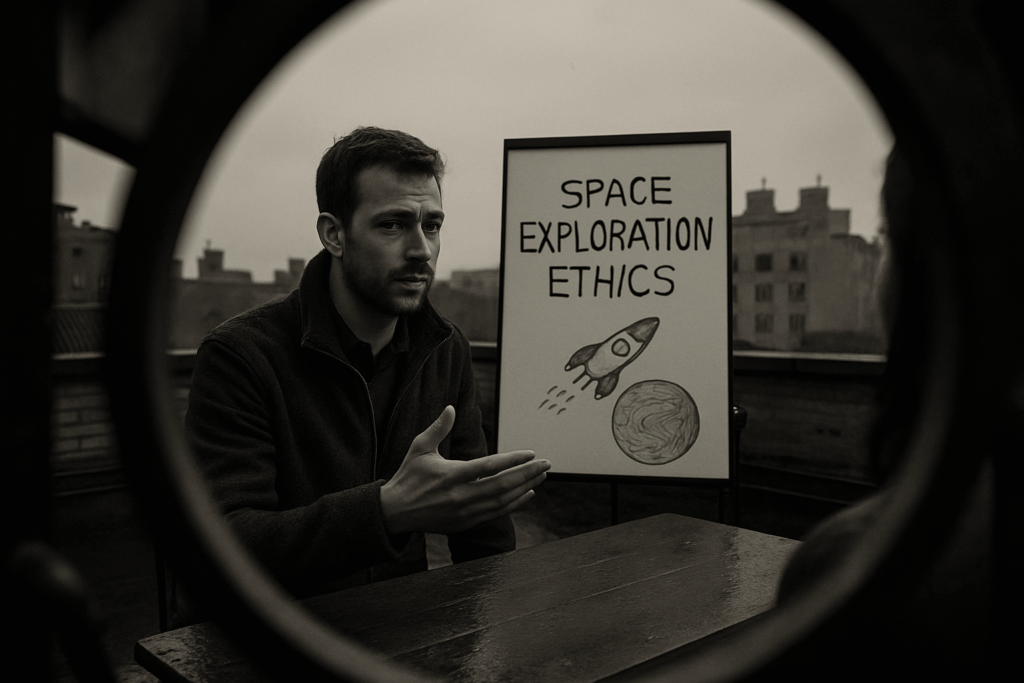
Who Gets to Decide?
At the heart of space exploration lies a complex question: who has the authority to shape our future beyond Earth? As humanity edges closer to permanent off world activity, the power imbalance in space governance becomes increasingly visible.
The Power Players in Space
The traditional image of space exploration led by national agencies has evolved. Today, authority is fragmented among a small group of influential actors:
Governments with established space programs (e.g., the United States, China, Russia)
Billionaire backed ventures such as SpaceX, Blue Origin, and Virgin Galactic
Private corporations developing orbital tech, satellites, and lunar missions
These actors are setting the agenda, often without broad democratic oversight. This shift raises urgent ethical questions about access, representation, and control.
Regulation Vacuum: A Global Concern
Despite the exponential growth of space activity, international law has not kept pace. There is no binding, enforceable global framework guiding how space resources are used or who gets priority in planetary exploration.
No centralized authority oversees environmental, commercial, or territorial claims in space
No mechanism ensures that all nations and peoples are equally represented in off world decision making
Lack of transparency fuels concerns about unchecked economic exploitation and geopolitical dominance
The Outer Space Treaty: A Patchwork of Promises
The 1967 Outer Space Treaty is often cited as the foundation of international space law. While it provides general principles such as keeping the Moon free from national appropriation it leaves many critical issues unresolved:
Who enforces these principles?
What counts as peaceful use?
How are corporate activities regulated?
Why This Matters Now
As privatized missions ramp up and lunar or Martian settlements move from science fiction to policy drafts, the absence of comprehensive global governance could lead to deep injustices mirroring or even magnifying the inequalities we see on Earth.
Related reading: Tech Influence in Governance
This isn’t just a technical debate it’s a moral one. Who gets to decide the rules of the next frontier, and who gets to participate in shaping not just using that future?
Stewardship or Extraction?
The idea of mining asteroids sounds like sci fi gold literally. Water, platinum, rare earths floating out there, untouched. For private companies and governments with deep pockets, it’s a tempting pitch: infinite resources without the messy politics of Earth. But here’s the reality space isn’t a reset button. What we do out there echoes what we’ve done down here.
Earth’s history with extraction is a highlight reel of shortsighted gain: deforestation, pollution, exploitation, inequality. We can’t walk into space acting like the bill will never come due. If anything, the stakes are higher. There are no ecosystems to regenerate, no indigenous stewards to learn from just a thin agreement (the Outer Space Treaty) and a dangerous amount of ambition.
Preserving space as a commons means resisting the urge to immediately capitalize. It means viewing off world resources as shared assets, not corporate jackpots. There’s space for innovation but it has to be guided by limits. Ethics shouldn’t trail behind the tech. If we take only what we need, and if we set real boundaries early, maybe we don’t have to repeat the same old story up there.
Colonization or Coexistence?

The word “colonization” drags a lot of baggage with it. For many, it recalls centuries of exploitation, displacement, and violence not exactly the kind of legacy we want to repeat off Earth. Yet that’s the term still tossed around when we talk about settling Mars or building moon bases. Language matters. It shapes mindset. If we enter space seeing ourselves as conquerors, we risk bringing the same extractive patterns that fractured ecosystems and cultures here on Earth.
So what would a responsible planetary settlement look like? Start with intent. Are we showing up to steward or to strip mine? To coexist with a new environment or dominate it? Responsible expansion means setting ethical guardrails before we ever launch. That includes sustainable resource use, preservation of space environments, and leaving room for future generations to make their own choices.
There’s also the cultural weight. The push to expand into space often comes from wealthy nations and private players. What histories, values, and norms get embedded in that process? Who gets excluded? Colonization isn’t just about land it’s about influence, memory, and power.
If space is a blank page, we should be careful what story we write on it. Because once it’s written, it tends to stay.
Who Benefits, Who’s Left Behind?
Space used to be a realm of curiosity, science, and international cooperation. But in 2024, it’s starting to look more like a high priced market. Rockets carry brand logos. Satellites serve shareholders. And while the frontiers expand, the gap between who gets to explore and who gets left behind is widening.
The reality is simple: public sectors fund the risk, private players take the prize. Governments pour billions into R&D and infrastructure. Then tech giants license the results and flip them into orbital startups. It’s a pattern we’ve seen before on Earth. Space, it seems, is not immune to venture capital logic.
Inequality isn’t just about money. It’s about influence. Decisions about Mars bases, lunar mining, or Earth to space transport aren’t being made by democratic consensus. They’re being made by a few CEOs in boardrooms with contracts, not citizens. And the more off world assets get privatized, the harder it becomes to regulate or reclaim them.
With companies like SpaceX, Blue Origin, and others effectively writing the rulebook as they go, the risk is clear: a future where space becomes gated, exclusive, and tailor made for profits, not people. If the trajectory doesn’t shift, space dominance could mirror Earth’s biggest injustice concentrated wealth shaping everyone else’s fate.
Related reading: Tech Influence in Governance
Ownership, Rights, and Responsibility
Who Has the Right to Own a Planet?
As humanity eyes planets and moons beyond Earth, a central ethical question emerges: Can a celestial body be claimed, bought, or owned? Current international law namely the Outer Space Treaty of 1967 prohibits national appropriation of space or celestial bodies. But the treaty leaves significant room for interpretation, especially in an era where private companies, rather than governments, are leading the charge.
The Outer Space Treaty forbids nation state ownership, but not corporate activity
Private interests may bypass ethical frameworks through legal gray areas
No clear global consensus on ownership, leaving emerging space powers to self regulate
Rights Beyond the Present Generation
Space exploration isn’t just about us it’s also about who comes next. Decisions we make today will shape the extraterrestrial environments future generations will inherit. This raises profound moral questions:
Do future generations have a right to inherit undeveloped or untouched space?
What ethical protocols must be in place to protect their interests?
Should space be preserved as a commons, not consumed as a commodity?
And what if we’re not the only sentient existence in the universe?
Considering Non Human Life
Exploring space means we may eventually encounter previously undiscovered ecosystems or even intelligent life. Our actions could unintentionally destroy or disrupt these environments before we understand them.
Do we ascribe moral rights to potential microbial or intelligent alien life?
What obligations do we have to unknown ecosystems?
Should we pause exploration until we can better assess the impact?
Reflecting on Civilization’s Trajectory
Ultimately, space exploration reveals not just where we’re going, but who we are becoming. The technologies, values, and ethics we carry with us into space will define the next phase of civilization.
Key questions to consider:
Are we extending extractive, colonialist behavior into the stars?
How do we balance ambition with responsibility?
Can we imagine a version of space exploration rooted in stewardship, equity, and interdependence?
Space doesn’t just test our science it tests our values. The question isn’t whether we can go, but whether we’re going well.
The Case for Slowing Down
Humanity moves fast tech faster. But when it comes to space, maybe speed isn’t our friend. We’re on the verge of planting flags on Mars, mining asteroids, and building off world habitats before we’ve settled the basics: who’s in charge, who benefits, and what values guide the mission.
There’s a growing case to hit pause not to stop, but to slow down. Ethics aren’t bugs you fix after launch. Rushing into space with Earth’s worst habits intact extraction, inequality, short sighted gain sets us up for a repeat performance in a much higher stakes theater.
Instead, we could choose reflection over reaction. Space should challenge us to think beyond markets and metrics. What does planetary humility look like? It means acting as if we’re guests, not owners. It means planning for the long term, even if it means fewer headlines.
Slowing down doesn’t mean giving up ambition. It means re centering purpose. Colonizing space isn’t just about rockets it’s about the kind of civilization we want to become. Maybe the real frontier isn’t out there, but in how we carry ourselves when we finally get there.